Everything I Know About The Pirates Of Penzance
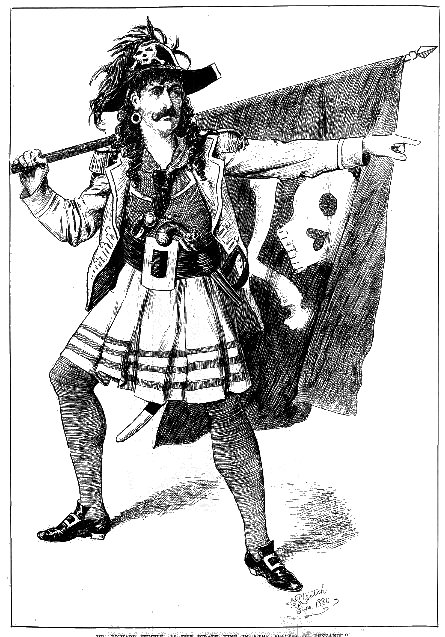
First published September 19th, 2025, last edited September 25th, 2026
I love Gilbert and Sullivan's comic opera "The Pirates Of Penzance" and particularly the 1983 movie with Kevin Kline and Angela Lansbury. I was exposed to it at the young and impressionable age of two by my wonderful grandmother, and have been obsessed with it ever since. I am no longer two years old, and I have learned a great many things in the years that followed. In this article I aim to document the everything I have learned about "The Pirates Of Penzance".
I'm going to assume basic familiarity with "The Pirates Of Penzance", such as knowing the names of the characters as well as basic plot summary, if you've watched nearly any adaptation of it then you should be fine. If you haven't seen it, or if you haven't seen the 1983 movie, I would highly recommend you do so.
A large thanks to the website Gilbert and Sullivan Archive and the book "The Complete Gilbert And Sullivan" as much of what I write is based on the information from these two main resources.
The Original "The Pirates Of Penzance"
"I will not have another libretto of mine produced if the Americans are going to steal it. It's not that I need the money so much, but it upsets my digestion" - W. S. Gilbert
This section will strictly deal with the original "The Pirates Of Penzance", as written by Sir W. S. Gilbert and Sir Arthur S. Sullivan from 1879.
The (Copyright) Pirates Of Penzance
In 1878, after the success of Gilbert and Sullivan's "H.M.S. Pinafore" in Britain, many US theaters legally pirated the work due to Gilbert and Sullivan only having British copyright on the work, and not owning the rights for it in the US. To prevent this loss of revenue for Pirates, they ran a single performance on December 30th, 1879 in the Royal Bijou Theatre, Paignton to secure British copyright. The following day, they opened on Broadway, at Fifth Avenue Theater in New York, with Sullivan himself conducting. Later, on April 3rd, 1880 they opened in London at the Opéra Comique. Gilbert made lots of reductions to the original script for the London premiere.
The Paignton performance was haphazard; It was ran by the touring H.M.S. Pinafore company after only a day with the complete music, a single rehearsal, and whatever costumes they had on hand, delivered to an audience of less than fifty (and only a single paying audience member, who had his fare of one guinea was returned to him after the show). The actors read their lines directly from parts of the script they brought onto the stage with them. It was scheduled for the 29th, but postponed to the 30th because they needed more time to rehearse (as the ship with the music had only just arrived the day before). For these reasons, as well as the many strange changes it made, I do not believe it to be a canon Pirates performance despite being the first, I think it was rather solely to get British copyright (I will, however, use it as a reference when it corroborates the other performances, instead of contradicting them).
The New York performance was not without issues either, Sullivan left his shorthand for the first act back in england and had to redo it as well as the overture. In a letter to his mother he complained about how hard he had been working to get the first act ready for the performance in time: "the last three weeks have been imprisonment with hard labour, never going to bed before 5:30 in the morning, sometimes later". This may explain why the Paignton performance had such little time with the full music.
If you are interested in the differences the three main premieres had, I'd recommend checking out "Definitive Pirates" by Ian Bond. It is a color-coded libretto of all three versions, along with a few annotations.
Personally, my favorite of these is the New York edition, the difference between it and the London version is a longer finale and a few extra lines, but for the most part they are identical.
- Paignton performances: 1
- New York performances: 100
- London performances: 363
Original Names
Quite a few characters are never explicitly named in most productions, including the Pirate King, his second in command, and the sergeant of police. However, all of these characters (and a few others), actually do have canon names, here is the complete list:
The Pirate King (named "Thomas" in Paignton, "Richard" in New York)
Samuel (the Pirate Lieutenant, exists in all versions, my favorite character)
James (a pirate, presumably the third in command, only exists in the Paignton version, part filled by Samuel normally)
Sergeant of Police (named "Edward" in New York)
Frederic (spelled "Frederick" in Paignton)
Major General's Parents
An important part of Act I is when Major-General Stanley lies to the pirates and tells them that he is an orphan. While it may be surprising that someone as old as he appears to be still has at least one living parent, it is confirmed in the Paignton version that not just one, but both of his parents are alive and living near him in that same scene:
[In all versions]
Pirates: How sad, an orphan boy

[Paignton only]
[Sung in parallel]
    General:
        Oh what a story I am telling
        My parents close to us are dwelling
        These simple pirates I am selling
        Oh what a story I am telling.

    Girls:
        Oh what a fib papa is telling
        His parents close to us are dwelling
        These simple pirates he is selling
        Oh what a fib papa is telling

    Pirates (in tears):
        Ah sad indeed the tale he's telling
        And pity from our bosoms welling
        All ferocity is quelling
        Sad indeed the tale he's telling
Rocky Mountains
The song "Climbing over rocky mountain" was not originally written for Pirates, instead it was written for Gilbert and Sullivan's first operetta, Thesipis (often referred to as "The Lost G&S Operetta" due to only the libretto, two songs, and some ballet music being known).
Climbing over rocky mountain,
Skipping rivulet and fountain,
Passing where the willows quiver
By the ever-rolling river,
Swollen with the summer rain,
Threading long and leafy mazes,
Dotted with unnumbered daisies,
Scaling rough and rugged passes,
-Climb the hardy lads and lasses
+Climb the hardy little lasses
-Till the mountain top they gain.
+Till the bright seashore they gain.
-Fill the cup and tread the measure,
+Let us gaily tread the measure,
-Make the most of fleeting leisure,
+Make the most of fleeting pleasure,
Hail it as a true ally,
Though it perish by-and-bye.
Gilbert himself actually forgot about this, and only remembered when a fan noticed and wrote to him about it.
"Pirates Of Penzance" (1980-1983)
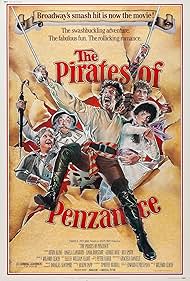
"Mr. Kline proceeded to goof gloriously" - Dudley Clendinen, The New York Times, 1981
This section is about the broadway version of Pirates from 1980, the movie from 1983, and the recording that happened sometime between them.
The Recording
The version of Pirates on most music streaming platforms (Apple Music, Spotify, etc...) that claims to be from 1983 is actually from a later performance of the 1980 Broadway version, which is almost definitely not from 1983.
Cast Differences
The 1980 and 1983 casts were very similar:
Main crew:
Wilford Leach (Director)
Joseph Papp (Producer)
William Elliott (Composer)
Graciela Daniele (Choreographer)

Main actors:
The Pirate King: Kevin Kline
Mabel Stanley: Linda Ronstadt
Major-General Stanley: George Rose
The Sergeant: Tony Azito
Frederic: Rex Smith
- Ruth: Patricia Routledge, played by Estelle Parsons for the recording
+ Ruth: Angela Lansbury
- Samuel: G. Eugene Moose, played by Stephen Mo Hanan for the recording
+ Samuel: David Hatton, sung by Stephen Mo Hanan
- Soloist[?]: Alix Korey
- Edith Stanley: Alice Playten, played by Alix Korey for the recording
+ Edith Stanley: Louise Gold, sung by Alix Korey
- Kate Stanley: Marcie Shaw
+ Kate Stanley: Teresa Codling, sung by Marcie Shaw
- Isabel Stanley: Wendy Wolfe
+ Isabel Stanley is not a named daughter in the 1983 film

There were no other similarities that I saw in other crew, pirates, police, or misc daughters
My main source for this was: https://oakapplepress.net/gasdisc/pirpapp.htm. I recommend checking out that article, as it presents what is probably a more rounded and less rose-tinted view of the movie than I do.
Completely unrelated, but I would like to mention that Tim Curry played the Pirate King in Joseph Papp's 1982 production of Pirates in London, and in fact he is the one pictured on the cover of the red program: 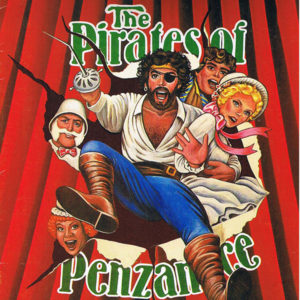
At Least One Animal Harmed In The Making Of This Film
In the 1983 film, while Mabel is singing "Poor wand'ring one" to Frederic (at about 35:28), a bird flies behind his head, hits the backdrop of the set, and falls out of view. It is unknown if the bird lived, but I have seen birds hit my window harder and live, so I am hopeful.
"My Eyes Are Fully Open"
The song "My Eyes Are Fully Open" sung by Frederic, The Pirate King, and Ruth in the second act is not originally from Pirates, rather is adapted from "Ruddigore", another Gilbert & Sullivan operetta which had a similar trio sing the song. This has lead me to wonder if Ruth's line "So I'll sing this song for ruddy good" is really "So I'll sing this song from Ruddigore", in the versions with Patricia Routledge it definitely is "from Ruddigore", but otherwise it's ambiguous (and the movie subtitles say "for ruddy good")
If you'd like to see the version with Patricia Routledge, I'd recommend this clip from the Broadway production of it: "It Really Doesn't Matter", and if you'd like to see the original song, I'd recommend this clip from 1982 film of it: "ruddigore 45 So it really doesnt matter". Ruddigore (1982) it takes itself a bit more seriously that Pirates (1983), and it's definitely worth a watch for G&S fans.
"Sorry Her Lot"
The song "Sorry Her Lot", from "H.M.S. Pinafore" also appears in the recorded and broadway versions, but not the movie. It is sung by Linda Ronstadt as a tribute to her older sister Gretchen who inspired Linda's love of Gilbert and Sullivan in the sixth grade by singing that same song.
Source: https://ronstadt-linda.com/prodnote.htm
Incorrect Subtitles
As far as I can tell, the subtitles for the movie are incorrect in two places.
During the Major Generals song, the subtitles say "round a horse" instead of "rode a horse". This one is pretty minor.
Just after that song, the pirates parallel lines are not shown:
[Sung in parallel]
[Girls, shown]
    He is telling a terrible story,
    Which will tend to diminish his glory;
    Though they would have taken his daughters
    Over the billowy waters,
    It is easy, in elegant diction,
    To call it an innocent fiction,
    But it comes in the same category
    As telling a regular terrible story.
[Pirates, not shown]
    If he's telling a terrible story,
    He shall die by a death that is gory;
    Yes, one of the cruelest slaughters
    That ever were known in these waters,
    It is easy, in elegant diction,
    To call it an innocent fiction,
    But it comes in the same category
    As telling a regular terrible story.
This is slightly worse, as it leads people to believe that the pirates were singing how they knew it was a lie, when instead they were promising death on General Stanley in the case it turned out to be a lie.
Tremorden Castle
One great joke that sadly did not make it into the movie was the fact that the Major General's ancestors don't reside in what he calls "the tombs of my ancestors" in Act II:
[General.]
Why do I sit here? To escape from the pirates' clutches, I described myself as an
orphan; and, heaven help me, I am no orphan! I come here to humble myself
before the tombs of my ancestors, and to implore their pardon for having brought
dishonour on the family escutcheon.

[Fred.]
But you forget, sir, you only bought the property a year ago, and the stucco on
your baronial castle is scarcely dry.

[General.]
Frederic, in this chapel are ancestors: you cannot deny that. With the estate, I
bought the chapel and its contents. I don't know whose ancestors they were, but I
know whose ancestors they are, and I shudder to think that their descendant by
purchase (if I may so describe myself) should have brought disgrace upon what, I
have no doubt, was an unstained escutcheon.
This joke is in the 1980 Broadway version (and subsequently, the recorded version).
Minor other fun facts
- The overture was completely rewritten for the movie. The original is much less rambunctious.
- Much of the music was redone, it isn't redone as entirely as the overture was, but still changed enough to significantly annoy Gilbert & Sullivan purists (and delight me).
- The majority of non-spoken parts in the finale (ie, the fight and the crashing of a production of the H.M.S Pinafore, the dogs) was not in the 1879 script
- Angela Lansbury was 47 in 1983 at the time she played Ruth, who is famously also 47.
- The odd accent Major General Stanley puts on when saying he is an orphan ("I yam an arphan boy!"), is a mimicry of a stereotypical cockney street urchin accent.
- "How Beautifully Blue The Sky" is missing from the movie, but is included in the recording and broadway versions.
- One verse of the Major General's song ("I know our mythic history [etc...]") was not included in the movie, but is included in the recording and broadway versions.
- The medals worn by the Major General and Samuel are not replicas of real medals, but fake props (this made my Stanley cosplay a bit trickier).
Misc
This part is just some fun stuff I wanted to add, that doesn't fit well into the other categories
References in other media
Some people and media which referenced Pirates:
- "Mickey, Donald, Goofy: The Three Musketeers": There is a play of Pirates inside it
- Theodora Morse: Wrote the song "Hail, Hail, the Gang's All Here", popular 1917 parody of "With Cat-Like Tread"
- Spindrift (band): Covered quite a few songs from Pirates of Penzance
- "Are You There God? It's Me, Margaret." (Movie): Margaret and her grandmother see a production of Pirates
- "Psych: The Musical": Shawn tells Gus not to "be the very model of a modern major-general."
- "Banquets of the Black Widowers" by Isaac Asimov: There is an argument over what year Pirates is set, 1873 or 1877.
Specifically "Modern Major General"
- "VeggieTales: The Wonderful World of Autotainment": Archibald Asparagus sings it
- Minions 3: Minions sing a gibberish parody of it
- XKCD: Parody
- Tom Lehrer:
- Parodied it for "The Elements"
- Parodied "If You Give Me Your Attention" from "Princess Ida" for "The Professor's Song"
- Parodied and their style of patter songs in "Clementine"
- Hamilton: "Right Hand Man" references it
- Animaniacs: Parodies it
"Dick Deadeye", or, why I'm writing a Pirates fanfiction
As I mentioned in the "Original Names" section, the Pirate King's name was Richard in the New York. As well, in H.M.S. Pinafore there is a antagonistic sailor named Dick Deadeye, and in Ruddigore there is a young sailor named Richard Dauntless. So three seafaring characters with the same name.
I am not the first to pick up on the fact that there are two sailors named Richard, and in 1975 "Dick Deadeye, or Duty Done" was released, which blends together quite a few Gilbert and Sullivan operas into an animated movie with the main character being none other than "Dick Deadeye", who also plays the part of Richard Dauntless (it has the Pirate King as a separate character).
Unfortunately, "Dick Deadeye" isn't great. The singing is awful at times, the instrumentation is bizarre, and the animation (while I do love Ronald Searle's style) is dampened by everyone looking like a caricature of themselves. All in all, I was rather disappointed by it, but I would still recommend watching it if you are a fan of multiple works Gilbert and Sullivan.
Minor
- "The Bab Ballads" by Gilbert have quite a few cute drawings of Pirate's characters in it: https://gsarchive.net/pirates/bab/bab.html
- There is a Yiddish adaptation called "Di Yam Gazlonim"
- There are adaptations for the music for a galop, lancers, polka, quadrille, and waltz (all arranged by Charles d'Albert)
- The full title is "The Pirates of Penzance, or, The Slave of Duty" ("The Pirates of Penzance, or, Love and Duty" at Paignton)
- Penzance has no "rocky mountains" on which to skip
- The line "In 1940 I of age shall be" can be used to find out when Pirates is set, it could either be 1873 or 1877 (depends on whether or not Gilbert knew that 1900 wasn't a leap year), to complicate matters, it definitely takes place after Pinafore is produced ("that infernal nonsense Pinafore"), which was early 1878.